Agricultural and farm solar, with solar VSD pumping
Ground-mount and rooftop solar, battery storage and solar VSDs for irrigation and borehole pumps on farms in Gauteng, Limpopo and across South Africa.
Farm solar cuts a farm’s electricity and pumping costs by generating power on site. Green Leaf Alternative Solutions designs and installs ground-mount and rooftop solar PV, battery energy storage (BESS) and solar VSDs (variable speed drives that run irrigation and borehole pumps directly from solar) for farms and agri-businesses, mainly in Gauteng and Limpopo and across South Africa. Farm businesses can buy the system outright, or use lease and PPA finance options, available directly or through a finance partner, to reduce upfront capital. Green Leaf has completed 1,500+ projects with 21MW+ installed. Every quote follows a free site assessment of your loads, pumps and land.
Green Leaf does systems from 5kW residential to 10MW industrial through its different divisions. It is a PV GreenCard Certified Installation Company (INST-9619573), a certification issued by SAPVIA, and an ECB Listed Contractor (29820).
Company totals: 1,500+ projects · 21MW+ installed
Service area: mainly Gauteng and Limpopo, with projects anywhere in South Africa
Send us 12 months of bills and your pump details and we’ll size a system for your farm.
Office: 011 705 2427 · Wayne (Sales): 081 515 8659 · WhatsApp Wayne (Sales): 081 515 8659
Where farms spend on electricity
On most commercial farms the biggest electricity and fuel costs sit in a handful of loads: irrigation and borehole pumping, cold rooms and packhouse refrigeration, dairy milking and cooling, poultry-house ventilation and heating, and workshop and processing equipment. Many of these run through the middle of the day, when a solar array produces most of its power, and pumping in particular is often done on diesel where there is no grid supply at the borehole.
That daytime profile is what makes farm solar work. Grid tariffs keep rising: Eskom’s direct tariffs rose 8.76% from 1 April 2026, with a further 8.83% approved for 1 April 2027 (Engineering News, 10 Mar 2026). Power you generate on the farm replaces power bought at those tariffs, and a solar VSD replaces diesel burnt at the pump. We start every farm project by mapping where your money goes: which pumps run when, what the cold store draws overnight, and what your tariff charges for energy and demand.
Ground-mount and rooftop solar for farms
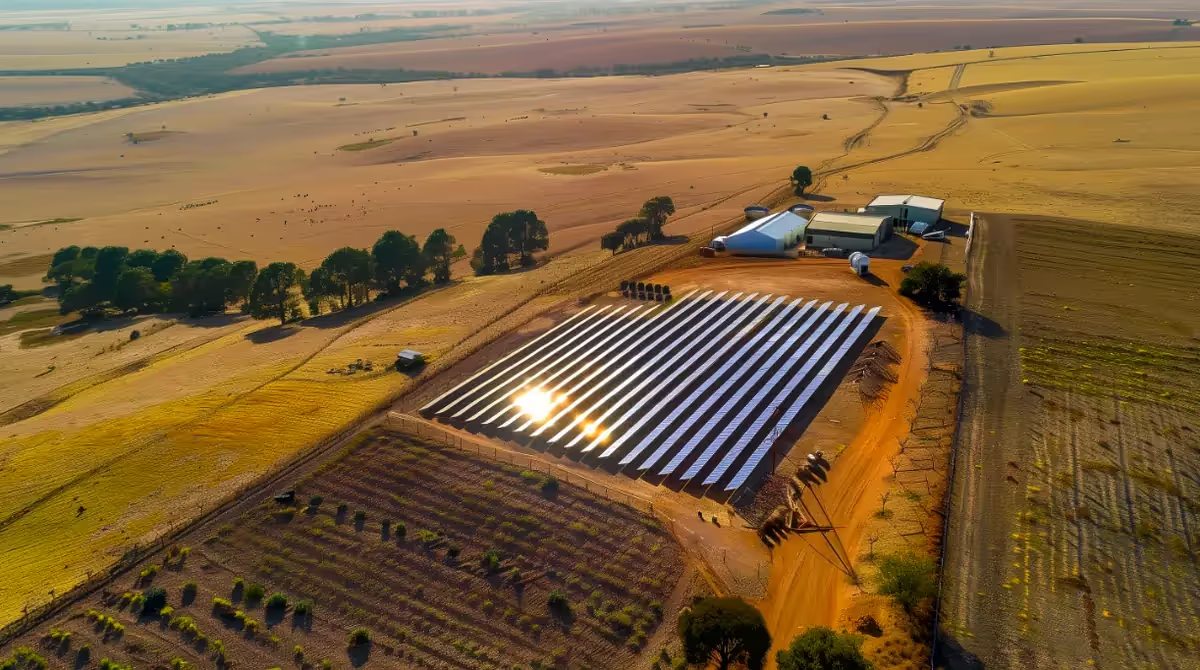
Farms have two things most industrial sites lack: open land and long distances between loads. That changes the design. A ground-mount array can sit on unused ground next to the pump station or the main distribution board, oriented and tilted for the best yield rather than fixed by a roof pitch. It is easier to clean and inspect, and easier to extend when you add a pump or a cold room later.
Rooftop solar still fits well where the roof is sound and the load is underneath it: packhouses, dairies, poultry houses, implement sheds and cold stores. We check the roof structure and sheeting before we design anything, and we look at the distance between the array and the load, because long cable runs cost money and lose power.
Many farms end up with a combination: a ground-mount array feeding the pumps through a solar VSD, and a rooftop array on the packhouse or dairy feeding the daytime load there. After commissioning, thermal drone inspections can check a ground-mount array for faulty panels and hotspots that are not visible in ordinary light.
Solar VSDs for irrigation and borehole pumps
Pumping is where farm solar pays off most directly. A solar VSD (variable speed drive, sometimes called a solar pump inverter or solar VFD) lets an ordinary AC irrigation or borehole pump run on solar power without a battery.
What a solar VSD does
The drive takes DC power straight from the solar array and converts it to AC for the pump motor, adjusting the motor speed to match the sunlight available. In full sun the pump runs at rated speed; as clouds pass or the sun drops, the drive slows the motor rather than stopping it, so pumping continues at a lower flow and restarts automatically when the light returns. Over a day the pump moves water in proportion to the solar energy available, with no fuel and no grid energy charge for those hours.
Retrofitting existing pumps vs new pumps
In most cases the solar VSD is fitted to the pump you already have. The drive is matched to the motor’s rated power and phase, the array is sized to deliver that power through the pumping hours you need, and the existing pump, pipework and controls stay in place. Where a pump is undersized, worn or badly matched to the borehole, it may make sense to replace it at the same time. We confirm which route fits your pumps at the site assessment.
Grid or generator support when there isn’t enough sun
Irrigation schedules do not always wait for clear skies. Solar VSD installations can be configured with a grid or generator input alongside the solar array, so the drive draws on solar first and tops up from the other supply only when the array cannot meet the pump’s demand. The point is pumping-cost control: the farm uses the lowest-cost source available at each moment and keeps the irrigation cycle on schedule. The supported modes depend on the drive and the site, and we specify them in your design.
Pump sizes and brands supported
Solar VSDs are available for single- and three-phase pump motors across the range used on commercial farms, from small borehole pumps to large irrigation and centre-pivot pumps. The exact drive, motor power range and monitoring options are specified for each project once we have seen your pumps and boreholes. Tell us the number and kW of your pumps on the enquiry form and we will confirm what fits.
Battery storage (BESS) on farms
Not every farm system needs a battery. Daytime pumping on a solar VSD does not. Battery energy storage earns its place when a farm has loads that run after sunset, such as cold rooms, dairies and poultry houses, or when the tariff charges for peak demand. Stored solar then shifts to the evening load, and the battery can shave the demand peaks that set the kVA charge on the bill.
We size batteries from your actual load profile rather than a rule of thumb, and we design them to work with the solar array and the grid supply you have. See battery energy storage (BESS) for how commercial battery systems are specified.
Paying for it: buy, lease or PPA for farm businesses
A farm business can buy the system outright, which usually gives the lowest lifetime cost per kWh and lets the owner claim the Section 12B allowance. Where the farm would rather keep its capital for the season, lease and PPA options are available, directly or through a finance partner, to reduce the upfront capital the business needs.
Under a PPA the provider funds, owns and maintains the system and the farm pays for the solar electricity it uses at an agreed rate. Under a lease the farm pays a fixed monthly amount and can take ownership at the end of the term. These options are for businesses only, and we confirm eligibility with the finance partner for each project. Your written proposal sets out the terms for your farm. See solar PPA, lease or buy for business for a full comparison.
Tax: Section 12B
Under Section 12B of the Income Tax Act, a business that owns a solar PV system of 1 MW or less and uses it in its trade can deduct 100% of the cost in the year the system is first brought into use (SARS Guide IT39, renewable-energy allowances). The enhanced 125% allowance under section 12BA applied only to assets brought into use between 1 March 2023 and 28 February 2025 and was not renewed (Income Tax Act s12BA(4)(b); Forvis Mazars, 27 Mar 2025).
Only the owner of the system can claim the allowance, so it applies when the farm buys the system. Under a PPA the provider claims it; under a lease it depends on the structure. This is general information, not tax advice: ask your tax adviser how it applies to your farm.
SSEG registration on farms
A farm system that connects to the grid must be registered as small-scale embedded generation (SSEG) with the supplier: Eskom where the farm is supplied directly by Eskom, or the municipality where it is on a municipal supply. Systems over 100 kW register with NERSA. Off-grid pumping on a solar VSD with no grid connection at the borehole does not need SSEG registration.
Green Leaf handles SSEG registration as part of every project, and we confirm the process for your supply point at the site assessment. See SSEG applications.
How a farm solar project works with Green Leaf
- Free site assessment. We visit the farm, review 12 months of electricity bills, look at your pumps, boreholes, roofs and land, and map your daytime and evening loads.
- Design and quote. You get a system design (ground-mount, rooftop or both, with solar VSDs and battery storage where they pay) and a written quote.
- Finance option. Buy outright, or use a lease or PPA through Green Leaf or its finance partner to reduce upfront capital. See solar PPA, lease or buy for business.
- Installation and commissioning by our team, including the solar VSDs on your pumps.
- SSEG registration with Eskom or the municipality, handled by Green Leaf. See SSEG applications.
- Handover and support. We monitor performance and provide operations and maintenance, and thermal drone inspections can check the array once it is in service.
Timelines depend on the size and scope of the job; you get a project timeline with your quote. See our commercial and industrial projects for the scale of work we deliver.
Farm solar installer for Gauteng and Limpopo
Green Leaf Alternative Solutions is a solar EPC based in Kyalami Park, Midrand, working mainly in Gauteng and taking on farm and agri-business projects anywhere in South Africa, including Limpopo. Our commercial and industrial division designs and installs ground-mount and rooftop solar PV, battery storage and solar VSDs for irrigation, dairy, poultry, packhouse and cold-store operations, and Green Leaf does systems from 5kW residential to 10MW industrial through its different divisions.
We do the site assessment in person, our in-house team handles design, installation, commissioning, SSEG registration, monitoring and maintenance, and we know the Eskom and municipal SSEG processes. Green Leaf is a PV GreenCard Certified Installation Company (INST-9619573), a certification issued by SAPVIA, and an ECB Listed Contractor (29820), with 1,500+ projects and 21MW+ installed.
Accreditations
-
Green Leaf Alternative Solutions
- PV GreenCard Certified Installation Company (INST-9619573), a certification issued by SAPVIA, valid to 31 Mar 2027
- ECB Listed Contractor (29820), DoL GS06414, valid to 31 May 2027
- Dept of Labour Registered
The same credentials are listed on the About page.
Questions about farm solar and solar VSDs
Can solar reduce my farm’s electricity costs?
Yes. A solar PV system generates electricity on the farm during the day, which is when irrigation and borehole pumps, cold rooms, dairies and packhouses are usually running. Every kilowatt-hour the system supplies is one you do not buy from Eskom or the municipality, or burn diesel to pump. How much it cuts your costs depends on your daytime load, your tariff and the size of the system, so we size it from your electricity bills and pumping schedule at a free site assessment.
What is a solar VSD and how does it work on an irrigation pump?
A solar VSD is a variable speed drive that takes DC power from solar panels and drives an ordinary AC pump motor, varying the motor speed to match the sunlight available. In strong sun the pump runs at full speed; in weaker light it slows down rather than stopping. That lets an irrigation or borehole pump run through the day on solar alone, with no battery needed for daytime pumping. See solar VSDs for irrigation and borehole pumps.
Can a solar VSD run my existing borehole pump?
Often, yes. A solar VSD is usually fitted to an existing AC pump motor rather than replacing the pump. Whether your pump qualifies depends on the motor’s rated power, whether it is single- or three-phase, its condition, and how the pump is used. We confirm this, and size the solar array to match, at the free site assessment.
Should my farm use ground-mount or rooftop solar?
It depends on your roofs, your land and where the load is. Sound shed, packhouse and dairy roofs close to the main loads suit rooftop solar. Ground-mount suits farms with spare land near the pumps or the main distribution board, or where the roofs are too small, too old or too far from the load. Many farms use both: a ground-mount array for pumping and a rooftop array for the packhouse or cold store.
Do I need batteries on a farm system?
Not always. Daytime pumping on a solar VSD needs no battery. Battery storage earns its place when a farm has large evening loads, such as cold rooms, dairies and poultry houses, or pays peak demand charges that stored solar can shave. We assess this from your bills and load profile. See battery energy storage (BESS).
Can my farm business lease solar or use a PPA?
Yes. PPA and lease options are available to businesses, including farm businesses, directly or through a finance partner, and they reduce the upfront capital the farm needs. We confirm eligibility with the finance partner for each project, and your written proposal sets out the terms. See solar PPA, lease or buy for business.
Can I claim Section 12B on farm solar?
If your farm business owns the system, uses it in its trade and the PV capacity is 1 MW or less, Section 12B allows a 100% deduction of the cost in the year the system is first used (SARS Guide IT39). Under a PPA the provider owns the system and claims the allowance; for a lease it depends on the structure. Ask your tax adviser before you decide how to fund the system.
Do you work in Limpopo?
Yes. Green Leaf works mainly in Gauteng from its base in Kyalami Park, Midrand, and takes on farm projects anywhere in South Africa, including Limpopo. We do the site assessment in person, so tell us the town or district on the enquiry form and we will confirm the visit.
How do I get a quote?
Request a free site assessment through the enquiry form or by phone. We review your electricity bills, pumps and land, then send a design and quote with the finance options available for your farm. Green Leaf pricing is by quote only, after the site assessment.
Talk to us about your farm
Use the enquiry form to request a free site assessment. Tell us your farm type, location and pumps, and attach an electricity bill if you have one. Where you have them, we review 12 months of bills, your tariff and your pumping schedule.
Office: 011 705 2427 · Wayne (Sales): 081 515 8659 · Support: 066 185 9010 · WhatsApp Wayne (Sales): 081 515 8659